Minority control appears after signing
The cap table says one thing. The veto list says another. A small holder can block decisions that a much larger group wants to make.

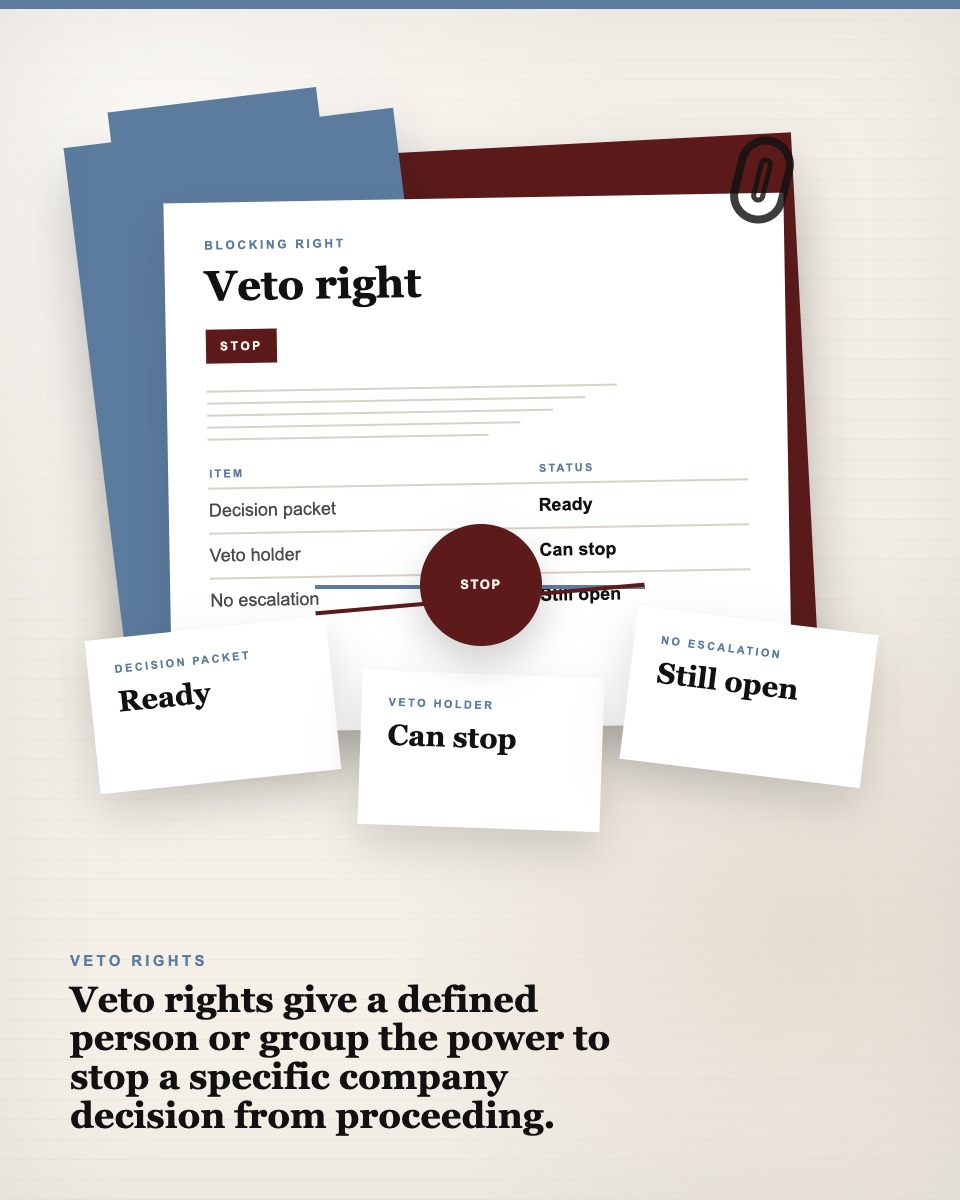
Veto rights give a defined person or group the power to stop a specific company decision from proceeding.
Plain definition
Veto rights are blocking rights. They usually appear beside reserved matters, protective provisions, board approval rights, or shareholder consent rights.
A veto right does not give someone the job of running the company. It gives them the power to stop a listed decision. That difference matters because a person can hold real control without carrying the operating responsibility.
A veto right is a stop sign placed inside the company's decision path.
What goes wrong
The cap table says one thing. The veto list says another. A small holder can block decisions that a much larger group wants to make.
The company needs a decision by Friday. The veto holder knows it. The approval conversation becomes a negotiation around pressure.
The agreement says who can block the decision. It says much less about what happens when the block remains in place.
Management learns which ideas will trigger a veto conversation. Soon the team only brings forward decisions that can survive the politics.
Founder questions
Bigger picture
Reserved matters are usually the list of decisions a veto right can stop.
Related structure Consent RightsConsent rights describe the approval mechanics behind many veto structures.
Related structure Deadlock ClauseA deadlock clause matters when blocking rights leave the company unable to close the decision.
Related reading
Board rights and veto rights can change how authority actually moves.
Related readingThe operating cost of authority that looks settled but behaves otherwise.
Related readingThe structural layer behind approvals, vetoes, and escalation.
Bring the document, the decision it is blocking, and the people whose authority is unclear.