Everyone has input and nobody has authority
The room feels collaborative. The decision never closes because every voice is treated as a veto.

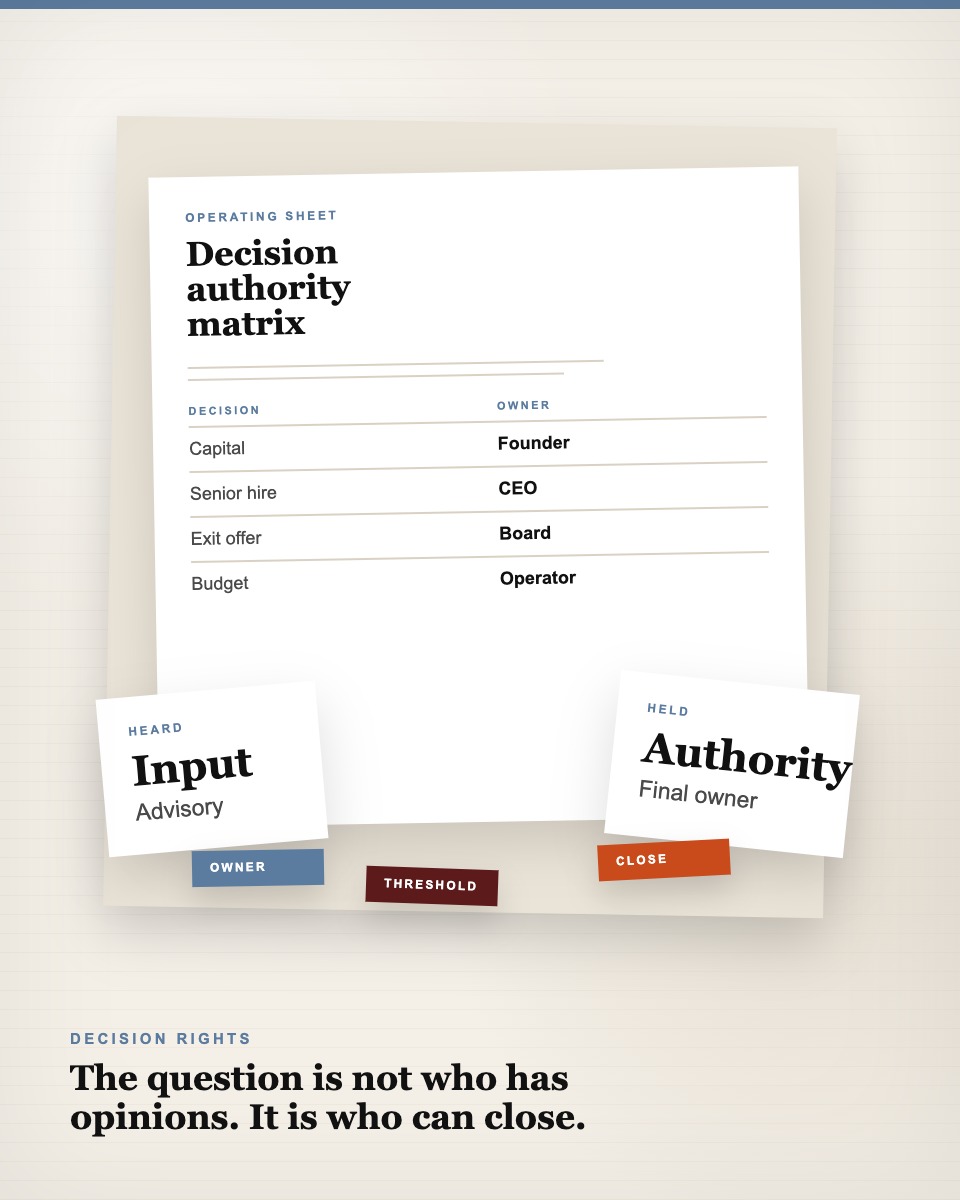
Decision rights define who has authority to make which decisions, at what threshold, and with whose input.
Plain definition
Decision rights are the operating version of authority. They say which decisions belong to the founder, CEO, board, executive team, investors, managers, or owners.
They can be written into governance documents, delegation frameworks, job scopes, board charters, or operating cadence. They also exist informally, which is where many companies get into trouble.
Decision rights are the difference between advice, input, approval, and actual authority.
What goes wrong
The room feels collaborative. The decision never closes because every voice is treated as a veto.
A leadership team appears authorized, but the founder keeps final authority through silence, facial expression, or late intervention.
Board members ask operating questions often enough that management starts treating them as approval gates.
A manager gets blamed for a decision they were never truly authorized to make. The system looks accountable after the fact and ambiguous before it.
Founder questions
Bigger picture
A deadlock clause is needed when decision rights reach a tie and no one can close the issue.
Related structure Governance GapThe governance gap widens when written authority and actual decision rights diverge.
Related structure The Founder Decision FrameworkThe Founder Decision Framework gives a practical way to sort decisions before they become authority problems.
Related reading
A working frame for sorting consequential founder decisions.
Related readingThe essay on why agreement cannot replace authority.
Related readingThe cost of authority that remains implied instead of named.
Bring the document, the decision it is blocking, and the people whose authority is unclear.